Venezuela Reprocessing
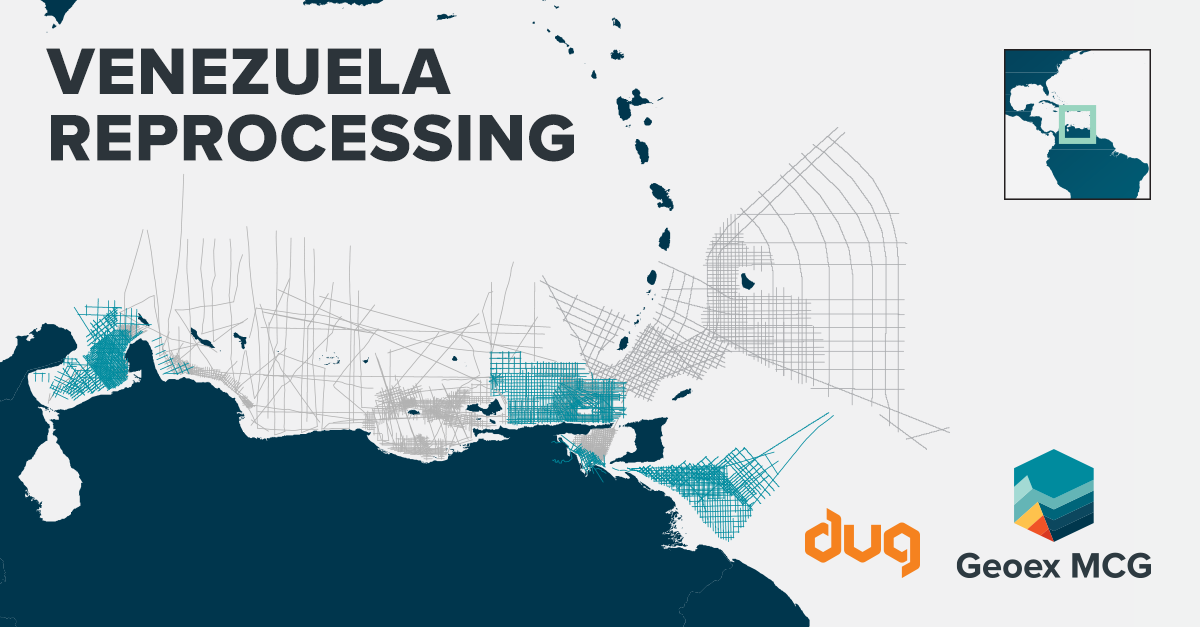
21 May 2026Approximately ~37,500 km of exclusive reprocessed datasets now available near the Orinoco Delta, Perla and Dragon fields
In partnership with DUG Technology, our ongoing reprocessing work is focused on illuminating offshore gas accumulations and identifying key prospects of interest. Whether you’re expanding your regional strategy or entering new acreage, this basin-wide synthesis offers unmatched insight and value for exploration decision-makers.
Executing on the Country’s Extensive Exploration Program
The reprocessing project is an integral component of a broader campaign aimed at re-evaluating the country’s extensive hydrocarbon potential and in particular increase the certification of its gas reserves.
Covering Venezuela’s entire offshore domain, the program is being delivered under Geoex MCG’s exclusive agreement with the Ministry of Hydrocarbons (MINHID), comprising:
- Over 50,000 km of New Detailed 2D Seismic Data (open to prefunding participation)
- Reprocessed 2D Seismic Data – Full Offshore Coverage
- Reprocessed 3D Seismic Data – Selected Areas
- Extended Geochemical Analysis
For more information and data viewing, please contact:
Jean-Philippe Rossi, EVP
jp.rossi@geoexmcg.com
Geology
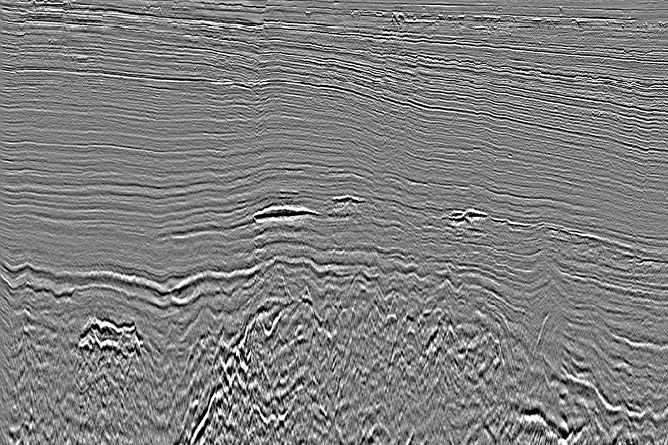
Offshore Venezuela represents one of the last high-potential frontier regions, with significant untapped opportunity.
Northern Venezuela’s tectonic setting, shaped by the interaction of the Caribbean, North American, and South American plates, has created a diverse and highly prospective geological environment. This has brought together all the essential elements for hydrocarbon success, including high-quality source rocks, strong reservoir sands and carbonates, and effective trapping structures.
To unlock this potential, Geoex MCG is advancing an ambitious offshore reprocessing programme, revitalising legacy seismic data to deliver clearer imaging and deeper geological insight. At the same time, four new surveys are underway in strategically selected areas, further enhancing coverage and highlighting the most promising exploration opportunities outlined below.
Golfo de Venezuela
Reprocessing across this region has significantly improved imaging of Oligo–Miocene carbonate systems associated with the Perla gas discovery, which are charged from Tertiary source rocks—distinct from the La Luna petroleum system of Lake Maracaibo. The combined datasets provide enhanced coverage from the Perla area through to La Vela and toward Lake Maracaibo, enabling improved interpretation of both carbonate build-ups and overlying sands. Multiple self-similar carbonate structures have been identified, with observable direct hydrocarbon indicators (DHIs) in some intervals, highlighting strong additional gas exploration potential.
Norte de Paria & Este de Margarita
This combined area provides a detailed and coherent view of the Carupano Basin, integrating improved imaging of Mio-Pliocene intervals associated with key gas discoveries such as Dragon, Hibiscus, Rio Caribe, Patao, and Mejillones. Modern reprocessing of legacy data, complemented by infill seismic coverage over Norte de Paria and the Los Testigos High, has significantly enhanced resolution of complex stratigraphic relationships, domal structures, and pinch-out plays. The datasets collectively allow for better delineation of leads and identification of secondary play types with strong DHIs. Proximity to existing infrastructure, including Atlantic LNG facilities, supports rapid monetisation potential through tie-backs.
Delta Amacuro (including Plataforma Deltana)
Despite being underexplored, the Delta Amacuro region shows strong hydrocarbon potential, supported by multiple nearby discoveries in moderately deep water with relatively shallow reservoir targets. Integrated reprocessing across the broader Plataforma Deltana provides full 2D seismic coverage, improving regional understanding of deposition and petroleum systems. Numerous structures analogous to producing fields have been identified, with similar DHIs observed in frontier areas, helping to de-risk exploration. The presence of shallow sands, combined with proximity to existing gas infrastructure and Atlantic LNG facilities, creates favourable conditions for fast-track development and monetisation.
Golfo de Paria – Aguas Llanas
The Venezuelan Gulf of Paria remains comparatively underexplored relative to the Trinidad side, where significant discoveries and production have been established. This dataset enhances understanding of the regional petroleum systems, particularly across the Corocoro and Pedernales fields. It provides valuable insight into reservoir distribution and charge, enabling evaluation of nearby (ILX) opportunities. The improved regional context supports identification of additional prospects within a proven but underdeveloped basin.